Review and photos by Gerry Frechette
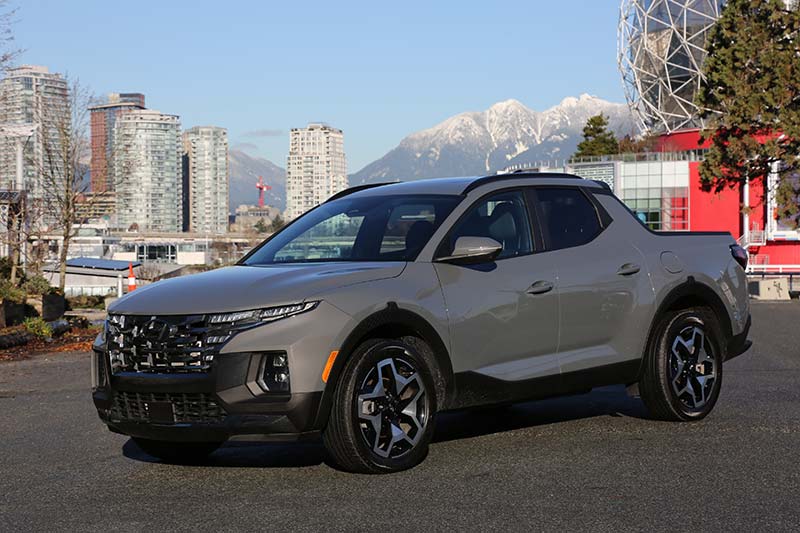
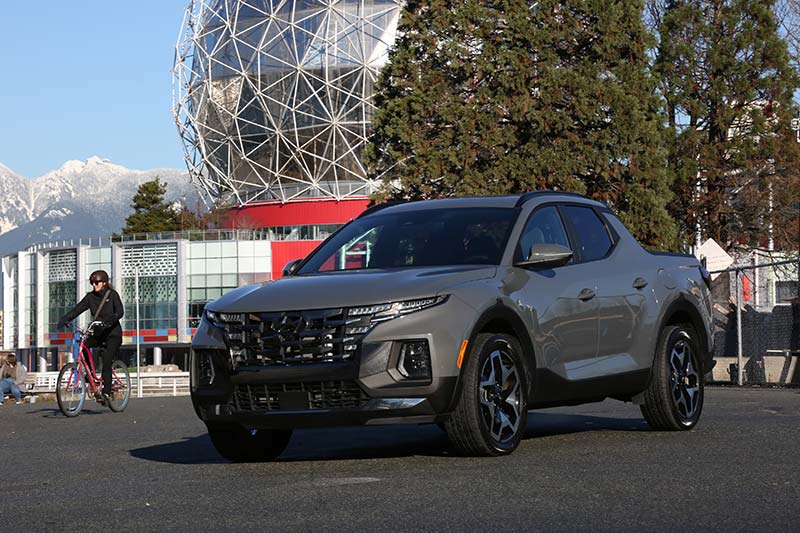
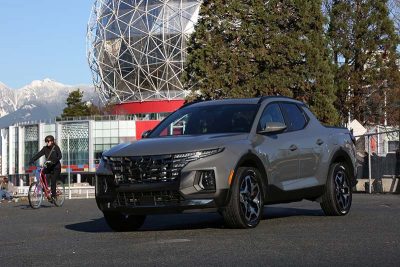 The Hyundai Santa Cruz is one of those vehicles that engenders all sorts of opinions and comments about just what its manufacturer was thinking when it was designed. One comment recently heard sums up just what most people wonder. “Is this thing a pickup or what?”
In support of a “yes” answer to that, it has a pickup bed at the rear end of it, which can be used open or covered, with a fold-down tailgate. And various items can be thrown back there that you wouldn’t want, or be able to fit, in a closed vehicle of this size. So in that sense, it is a pickup, or at least a truck.
But here, in the third decade of the 21st century, the lines are all blurred as to what a vehicle is, when you are talking about a crossover like the Santa Cruz. Hyundai prefers that it be called the first-ever “Sport Adventure Vehicle” and backs that up with equipment and capabilities that take it out of the realm of just being a pickup. Sure, that speaks to marketing and product planning, but it is not far fetched that active people would want such a vehicle.
 In our two weeks of urban driving in dismal December weather, we did not have the chance to use the Santa Cruz as anything more than a stylish urban attack vehicle that got lots of looks out on the road. But of course, we did get to try out that 52-inch-long rear cargo area, and the weather was perfect to prove the worth of the water-resistant rolling metal tonneau cover the SC comes standard with. Our bags and boxes stayed dry and secure, although not stationary, as they slid around on the composite surface. The cover slides easily, although not so much with any snow or ice built up on its surface. Also, on one very cold morning, the twisting lock knob on its underside froze in the locked position. Under the main bed is a lockable concealed small trunk, which will hold a couple of carry bags, or a few dozen beers on ice, as it has a drain plug.
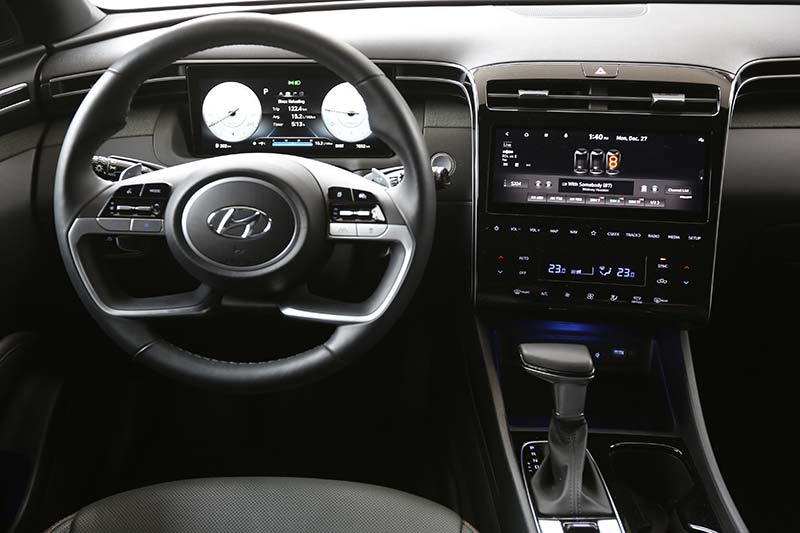
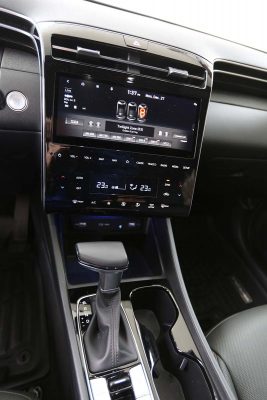
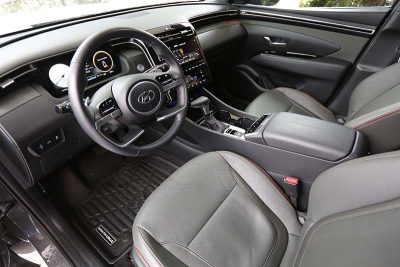
Inside, the SC is very nicely finished and equipped, especially in the highline Ultimate version we had. The driver’s part-leather seat is eight-way power adjustable plus lumbar, so even the tallest driver should feel comfortable. Tech goodies include the full suite of electronic safety features, 10.25-inch touchscreen navigation, Bose premium audio with satellite radio, surround-view camera, heated and cooled seats, and lots more.
The back seat space is a mixed bag, though. With either front seat all the way back, as a taller driver would want, there is not enough room back there for a normal adult’s legs. As well, the seat back is nearly vertical in its positioning, and doesn’t fold down to provide a cargo carrying option. The seat cushion does fold up to reveal a small storage area, most of which is taken by the jack. So, bottom line, that back seat is probably going to be the domain of the youngsters or pets in the family, or light items on the seat cushion.
What keeps the SC from being a home run in the utility department is that there is no physical connection between the rear cargo bed, and the rear seat area. The body structure between them is fixed. It would be very useful to have a folding seat back and some sort of sliding door arrangement that would help accommodate longer items. There is, however, a sliding glass panel in the middle of the rear window, through which skis could fit.
The word “Sport” is somewhat overused in this segment of vehicles, but the SC is one that actually has the performance that an enthusiast can appreciate. Under the hood resides a 2.5-litre turbo four with a lusty 281 horsepower and 311 pound-feet of torque as low as 1,700 rpm, which makes for very quick merging onto the highway, and effortless manoeuvring around town. The power goes out through an 8-speed twin-clutch manumatic transmission that shifts quickly and is always in a good gear, although it does sometimes exhibit a bit of hesitation at launch, as the clutches engage, which is typical of these units. Zero-to-100 km/h runs can be done in the six-second range, and the SC is rated for 5,000 pounds of towing.
 Htrac all-wheel drive is standard, and it has a centre differential that sends power rearward as needed, up to 50 percent of it in Sport mode, and uses torque vectoring to decide how much power each rear wheel gets depending on the situation. With the 245/50-20 all-season tires our tester had, we weren’t going far off-road to try it out, but it handled the packed and loose snow we encountered with no problems.
Suspension is Macpherson strut up front, and a multi-link set-up in the back, so that, combined with decent steering and brakes, makes the Santa Cruz one very nimble and dynamic feeling small truck, even given its two-ton weight. As mentioned, there is a Sport mode, which, like most of them, mainly holds the engine rpm’s a bit higher for more instant torque. There are also Normal and Smart modes, the latter equivalent to an Eco mode without the stigma of that term, while there are also off-pavement modes for Snow, Mud and Sand. It’s not a rock crawler, but the SC should handle the terrain on the way to the lake or cabin.
While doing that, it will get a level of fuel consumption that may be higher than you might expect, thanks to that big turbo four. In two weeks of urban driving, I just drove it in Normal with a couple of “Sport” episodes just to try it, and ignored my consumption, and it came out to 14.7 litres per 100 km. In my last 15 km on the way to returning it, I tried to be extra-gentle on the throttle in Smart mode, and it returned 12 litres, which is right on the Transport Canada city rating. They rate it at 8.6 litres on the highway. So, it can be done, but you may not like it as much to drive it.
The Ultimate model we drove will run you $44,799, while you can get a less-equipped (but still turbo AWD) base version for $38,499. A front-wheel drive non-turbo version is available in other markets, but not in Canada.
 So, if you are looking at the Santa Cruz, you would do well to give a lot of thought to what you are going to use it for, and perhaps compare it to Hyundai’s Tucson SUV, upon whose platform it is mostly based. The Tucson has a bigger covered cargo area, given the space goes right up to the roof, and more rear seat space, too. But the Santa Cruz has more power, a very useful pickup design for hauling gear and equipment, and that cool factor that can’t be quantified.
If you do kind of like the idea of a pickup for your active lifestyle, but want something stylish, dynamic, easy to drive, a good value and very well-equipped, the Santa Cruz might be your kind of truck. Just don’t let Hyundai hear you call it that.