New Competition: GMC Sierra 1500 Diesel vs Ram 1500 EcoDiesel
 Story by Jordan Allan, photos courtesy of GM Canada and FCA Canada
The popularity of pickup trucks in North America is seemingly at an all-time high, which is significant given that the entire automotive industry has seemingly shifted its focus to efficiency and economy. Sure, trucks are more efficient and practical then they have ever been before, but they are still very large and often feature large V8 engines under the hood, neither of which necessarily produce an economically friendly and fuel efficient vehicle.
Without a doubt, electrification is on the way, whether it be in the form of hybrid or full electric, but for now, it appears another, more efficient powertrain option is the focus. Within the last year and change, all three of GM, Ford and Chrysler (FCA) have released or re-released diesel versions of their largely popular half-ton full-size truck offerings. Although I’ve yet to drive the Ford version, I was lucky enough to be able to drive a Ram 1500 EcoDiesel and a GMC Sierra diesel on back-to-back weeks and thought it would provide a great opportunity to compare the two and see how they differ.
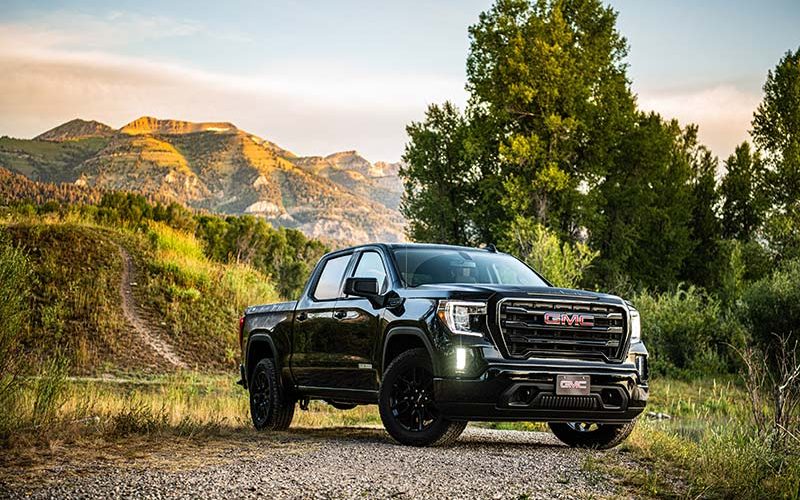
Before I get into any details about each one, it should be noted that although the trucks were essentially very much the same in that they were half-ton pickups with six-cylinder diesel engines, the Ram 1500 was in the Limited model which is the top of the Ram 1500 lineup, while the Sierra I drove was the Elevation model which is the third level out of five models. The amount of luxury added into the Ram 1500 Limited model was very apparent and the better comparison in the GMC lineup would of course be the Denali; however, for the purposes of this article, the Elevation would do just fine.
 The first thing to look at would be the overall appearance of the trucks, which is tough to compare as this is a completely subjective aspect. I will admit that I was not the biggest fan of this newest fifth-generation of Ram when it was first released, but that has definitely changed over time and I am now able to fully appreciate the bold yet contemporary design Ram has gone for. The black package on our also-black test truck looked incredible and perfectly accented by the LED lights, and the use of any chrome features was eliminated, which is something I am fine with.
Although the Elevation model is not at the top of the Sierra lineup as I mentioned, it is probably the model I would first look at based solely on appearance. Our test model had a cool, blueish, light grey colour GMC calls Satin Steel Metallic that featured black accents all round, including the grille, side mirrors and top of the rear bumper. As I said, looks are subjective but my guess is, the majority of people would choose the flashier Ram design; if it was me, though, I would go with the slightly more toned-down and rugged design of the Sierra.
Inside of these two specific trucks is where the Ram was able to truly shine, highlighted by the incredible 12-in. touchscreen with the Uconnect 4C infotainment system. This screen had amazing resolution, and offers split-screen capability which came in handy quite often. My biggest worry was that a screen that big would take a while to get used to, but this was not the case as everything was laid out nicely and the sheer size of the screen itself made it hard to miss anything. All other aspects of the Ram’s interior felt very luxurious and was more reminiscent of a true luxury car than a truck, and I mean that in the best way possible.
 The Sierra’s interior was also very well laid-out and quite practical, featuring lots of old-school knobs and dials which is something I, and I’m sure a lot of other people, prefer. It has, of course, a much smaller touchscreen, but again this one was very easy to use. The rest of the interior space also felt quite luxurious but to me it felt more like I was in a truck, which again is not at all a bad thing. High-quality materials are used throughout, the seats were very comfortable and there is just something about a column-style shifter in a truck that I find much more appealing than knobs or buttons. Again, a better comparison inside would be the Sierra Denali model, but even then I would have a hard time believing it would be as stunning as the Ram interior.
As you likely know, 2020 marked a new generation for the Ram’s 3.0L turbocharged EcoDiesel V6 that now features a class-leading 480 lb-ft of torque along with 260 horsepower, which together produce a payload of 2,040 lbs. and a towing capacity of 12,560 lbs. Introduced for the very first time in 2020, the also-turbocharged Duramax 3.0L found in the Sierra diesel produces an also-impressive 460 lb-ft of torque and a class-leading 277 horsepower. Although it produces more horsepower, the Sierra falls a little short of the Ram in terms of payload and towing capacity, posting numbers of 1,830 lbs. and 9,100 lbs. respectively. The horsepower-and-torque war has already been very prominent in the heavy-duty diesel-powered trucks offered by the Detroit Big 3, and it looks like this may be the case in the half-ton market as well.
As is the case with the power numbers, the fuel economy numbers are very similar as well. The Ram boasts an impressive 11.1L/100km and 8.0 on the highway for a combined 9.7L/100km while the Sierra produces an also notable 10.5L/100km in the city with a 9.1L rating on the highway for a combined 9.9L/100km.
 Driving each of the Sierra and the Ram were very different experiences, but each was excellent in its own right. The Ram felt much smoother and drove more like a car than a truck, which is especially handy when navigating tight city streets and parking lots. The Sierra also featured a luxurious and smooth ride but I found it harder to forget I was in a full-size truck which again is not always a bad thing. It may not have been quite as smooth or as effortless as the Ram, but it was still very easy to drive and likely feels like a luxury sedan when compared to trucks of the past.
Both trucks handled corners well and were able to easily get up to highway speeds when merging, but I have to say the Sierra felt noticeably quicker than the Ram, especially during acceleration. The Sierra felt quite peppy and wanted to break the wheels loose a few times during my rainy test week, while I felt the Ram was a little leggy on acceleration when in comparison. Given that the Ram does boast more torque and very similar horsepower numbers, I found it a little surprising how much slower it felt off the line. This in no way sullied my experience with the Ram, but it was clear the Sierra’s performance was more noticeable.
Both trucks feature all of the modern amenities you could want including USB ports, Apple CarPlay, Android Auto and even full 110-volt electrical outlets. Each test model had very large back seats that would be as useful for storage and cargo as they would be for passengers. The Ram test model came complete with the RamBox truck bed and factory-installed bed extender. The RamBox is a great idea and provides a secure, safe spot to stow things you don’t want rolling around in your backseat; however, it does sacrifice a good amount of bed space so pick and choose based on your needs there. Although it didn’t have the new, groundbreaking MultiPro tailgate, the Sierra was every bit as practical as the Ram and I’ve always been a huge fan of the steps integrated into each corner of the rear bumper, as it makes getting things in and out of the bed that much easier.
 It should be noted that both Ram and GMC have made the diesel engine option available on all of the trim models, which is something that was not usually done before and now gives entry-level buyers a chance to enjoy the benefits provided by these engines. The EcoDiesel starts as a $5,800 option when added to the lower Tradesman and Big Horn models, but for normally-equipped V8 models it adds $3,900 to the overall cost. The Duramax engine option in the Sierra 1500 comes in a little cheaper at just a $3,135 premium on all models.
Everybody likely has their own idea on what makes a truck great, and for me to sit here and tell you which one is better from my perspective is a pointless exercise. Each of these trucks is truly fantastic in its own right and goes about it differently than the other, which is part of what makes both of them great. One thing that can often help determine which direction to go is the value you feel like you’re getting when purchasing one, but given that the two examples I drove were on very different ends of the spectrum, it’s hard to make that call as well.
To put that in perspective, the Ram I drove had a final sticker price of $94,585, while the Sierra came in at $67,613. This is a sizable difference, but I’d be willing to bet that when spec’d right, you can easily get a Sierra Denali model up near $100 grand as well.
All that being said, at the end of the day it comes down to what you want from your truck and that is something only each individual buyer can know. Both of these trucks were truly enjoyable and I could see myself behind the wheel of either one but luckily for me, this isn’t a decision I have to make in the near future. What a relief!